
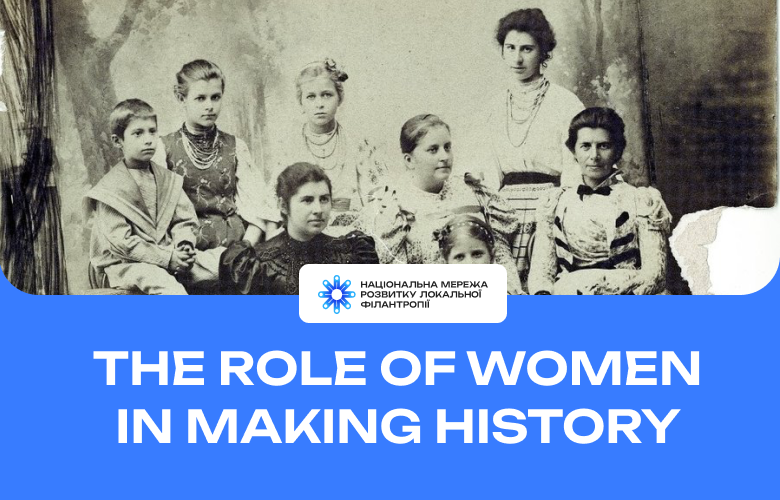
March 8 is not just about flowers and compliments; it is about strength, struggle, and the contribution of women to the world. From Kateryna Skarzhynska to MacKenzie Scott, women in philanthropy have played a key role in the development of society, supporting education, culture, medicine, and gender equality. Their work proves that women are free to create meaningful change in the world.
Kateryna Skarzhynska
In 1880, Kateryna founded the first private museum in Left-Bank Ukraine, although she had been collecting artifacts for five years before that. By the early 20th century, her private historical museum housed 20,000 exhibits, while its academic library already contained 4,000 volumes of books.
In her own estate in 1898, she built a school building. In the stone house, she allocated two rooms for the teacher’s residence, designated two classrooms, and equipped a recreation hall, a library, a daycare, a school museum, a school laboratory, and more. This was a logical continuation of her efforts, which had begun 18 years earlier.
Kateryna also collected a unique collection of Easter eggs (pysanky). Most of them were painted by folk artists, some were made in monasteries, and the rest were works of amateur artists. By 1898, the collection contained 2,123 pieces. In 1906, the Poltava Provincial Zemstvo’s Natural History Museum received all of Skarzhynska’s Easter eggs and prepared for publication the second volume of the collection’s catalog, which included 3,113 drawings, 1,181 cards, 58 photographs, and four notebooks with materials.
During Soviet times, the collection was exhibited in the Poltava Museum. In 1943, a significant portion was destroyed when the Nazis set the museum on fire. Only 458 items were saved.
MacKenzie Scott
In May 2019, Scott signed the Giving Pledge – a philanthropic campaign in which she committed to donating the majority of her wealth to charity during her lifetime or in her will. However, she not only invests her finances but also her knowledge, expertise, and media influence.
For example, in June 2021, she and Melinda Gates launched the “Equality Can’t Wait Challenge,” aimed at promoting gender equality and expanding women’s power and influence in the United States by 2030.
Scott believes that “teams with frontline experience best understand how to use money effectively.” In 2020, she published a list of 116 organizations she had financially supported. By the end of that year, she had provided funding to 384 organizations.
Olha Drahomanova
Olha engaged in ethnography, collected folk folklore, and compiled samples of traditional embroidery. In 1876, she published “Ukrainian Ornament,” which received praise from both Ukrainian and European scholars.
In 1880, she financed the publication of “Spivomovky” by Stepan Rudansky. While participating in the dramatic society in Lutsk, she suggested using money collected from performances to purchase Ukrainian books for the club library.
From 1906 to 1914, she published the magazine “Ridnyi Krai” (Native Land) with the supplement “Moloda Ukraina”(Young Ukraine) and the “Newspaper of the Hadyach Zemstvo.”
“Month after month, I invested my own money and lived in the hope that the situation would improve. Perhaps readers were afraid to subscribe, as some asked to receive the magazine under a different name, fearing repression at work for subscribing to a Ukrainian publication. It was painful both financially and morally, but I did not have the strength to abandon the cause and stop publishing,” she recalled in the book “Rebels: New Women and the Modern Nation.”
Priscilla Chan
Chan is a physician, and much of her philanthropic activity is related to medicine.
In 2016, she co-founded “The Primary School,” a nonprofit organization that provides education for children from first to twelfth grade, as well as prenatal care in California. She currently serves as the honorary chair of the school’s board.
In March 2017, she was one of six nominees for the Visionary of the Year award, presented annually by the San Francisco Chronicle.
Sofia and Olena Czartoryska
Around 1597, the sisters founded a hospital and a school for peasant children at a monastery. In their estate in Rakhmaniv, Volyn, they also established a printing house and translated the Holy Scriptures (as well as gospel and apostolic homilies) from Greek into Old Ukrainian.
Since Sofia was a passionate supporter of the Orthodox faith and education, she supported the well-known figure of the Lviv Brotherhood, Kyrylo Tranquillion-Stavrovetskyi, who authored the “Evangelie Uchytelnoe” (Didactic Gospel).

