Article
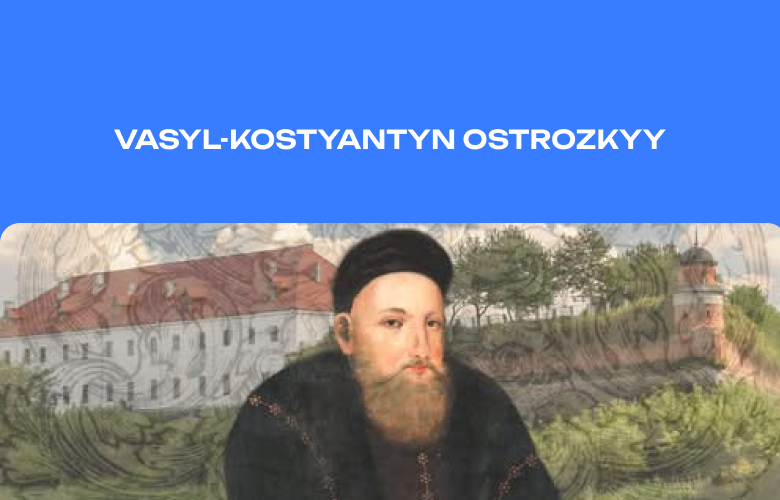
Vasyl-Kostyantyn Ostrozkyy was one of the most influential Ukrainian princes of the 16th century – a political figure, patron, defender of Ukrainian lands, and protector of the Orthodox Church. He is often remembered as the founder of the Ostroh Academy and the patron behind the publication of the Ostroh Bible. Yet these are only a few aspects of his broader work. He developed cities, fortified castles, defended the lands from Tatar raids, and created a space around himself in which Ukrainian lands could emerge as a distinct and fully-fledged world alongside other European states.
In this article, we explain why Vasyl-Kostyantyn Ostrozkyy can be seen as an example of Ukrainian philanthropy in the early modern era – philanthropy aimed at the long-term resilience and agency of an entire community.
Vasyl-Kostyantyn Ostrozkyy was born in 1526 into one of the most influential families of Rus’ at the time. His father, Kostyantyn Ivanovych Ostrozkyy, was an outstanding military commander and held some of the highest offices in the Grand Duchy of Lithuania. After his father’s death, the young Vasyl-Kostyantyn inherited the family name, and with it, a tremendous responsibility: to preserve and expand the family’s estates, strengthen its political influence, and care for the lands under his administration.
Over the course of his life, Ostrozkyy became one of the wealthiest men in the Polish-Lithuanian Commonwealth and in Europe more broadly. He owned vast estates: a significant part of historic Volhynia, towns and settlements in the Kyiv, Bratslav, and Galicia regions, as well as some territories in present-day Poland. According to researchers’ estimates, his annual income may have reached around 10 million zlotys, and his resources allowed him to maintain his own army of 15,000 to 20,000 men. For the 16th century, this was a scale of power and wealth not available to every European monarch.
The most important part of Ostrozkyy’s story, however, is not simply the scale of his resources, but how he used them. He systematically directed his wealth toward the common good: defense, education, urban development, support for the church, and the creation of an environment in which Ukrainian lands could preserve their dignity and autonomy.
One of Vasyl-Kostyantyn Ostrozkyy’s most important areas of activity was the defense of Ukrainian lands. In the 16th and 17th centuries, Tatar raids were among the greatest threats to the population of these territories. They destroyed towns and villages, took people captive, devastated local economies, and made life in the borderlands constantly dangerous.
Ostrozkyy maintained, at his own expense, a cavalry force of several thousand men to defend against Tatar raids. In the 1570s-1590s, he repeatedly repelled Tatar attacks, and his military and diplomatic actions were highly praised in the chronicles and writings of the time.
Vasyl-Kostyantyn Ostrozkyy also actively developed cities and castles. Settlements in Volhynia, the Kyiv region, and the borderlands were fortified at his expense or on his initiative. Examples include the castles in Bila Tserkva, Pereiaslav, and Bohuslav. All of them served as important strongholds on the border with the Wild Fields.
These fortifications allowed people to settle in previously dangerous territories and develop agriculture, trade, and local self-government. In this context, a city or castle was a guarantee of protection and a more secure future.
Ostrozkyy also played an important role in the reconstruction of the Kyiv region. As Kyiv voivode, he cared for a region that in the 16th century was exposed to constant attacks and had largely fallen into ruin. Historical sources indicate that in 1578 he even paid the Tatars 3,000 ducats to save Kyiv from plunder. In doing so, he sought to preserve the historical heritage deeply rooted in these lands. This action can be viewed as part of a broader effort to protect historical continuity and the distinctiveness of Ukrainian lands.
Ostrozkyy’s most famous educational project was the establishment of the Ostroh Academy. Its founding was one of the most significant steps in the history of Ukrainian education. The Academy became the first institution of higher education in Eastern Europe and an important center of intellectual life. Students there studied Church Slavonic, Greek, and Latin, as well as grammar, rhetoric, dialectics, and other disciplines.
The Ostroh Academy trained people who could work professionally with texts, engage in debate, translate, teach, and organize church and civic life. Many figures associated with its milieu later influenced the development of Kyiv, the Brotherhood Schools, and the renowned Kyiv-Mohyla intellectual center.
In this sense, Ostrozkyy’s educational activities were an investment in intellectual autonomy. Education gave the Ruthenian community the tools to defend its own traditions, engage in dialogue with other cultures on equal terms, and participate in the wider European intellectual sphere.
It is important to note that Ostrozkyy was deeply involved in the Academy’s practical development, including the recruitment of faculty and the publication of books.
In 1581, the Ostroh Bible was published in Ostroh – the first complete printed edition of the Bible in Church Slavonic. This project was of immense significance for the Orthodox world, education, theology, and broader book culture. Many scholars and translators worked on the text, and the publication itself required enormous organizational and financial resources.
Alongside the publication of the Bible, polemical literature flourished in Ostroh. Ostrozkyy supported authors, commissioned texts, printed them at his own expense, and rewarded those working in this field. Thanks to this, the community gained the opportunity to speak in its own voice.
Vasyl-Kostyantyn Ostrozkyy was one of the main patrons of Orthodoxy in the Polish-Lithuanian Commonwealth. He founded churches and monasteries, supported the clergy, cared for the education of Orthodox priests, and defended the rights of the Orthodox Church.
It is important to understand these activities within a broader context. In the early modern world, the church was also an educational, cultural, legal, and social institution. It shaped community life, preserved tradition, maintained the connection between generations, and defined the place of the Ruthenian elite in the political sphere.
His position on the Union of Brest was particularly important. Ostrozkyy opposed the model of church union which, in his view, threatened the rights of the Orthodox community. His uncompromising stance caused constant tension in his relations with the king and with some of the influential figures of the time, but he remained steadfast in his convictions.
One of the most important features of Vasyl-Kostyantyn Ostrozkyy’s work was his belief in the distinctiveness of the political and cultural space of Ukrainian lands. His opinion was taken into account in Kraków, Warsaw, and Rome. He was a figure through whom Rus’ emerged as a subject of history.
Interestingly, in some letters Ostrozkyy referred to himself as “by God’s grace, Prince of Volhynia.” Such a formula was characteristic of sovereign rulers and monarchs. However, this does not mean that Ostrozkyy sought to establish an independent state in the modern sense. His activities focused on preserving a space of autonomy: with its own educational institutions, church policy, military force, cities, administration, printing, and cultural program. He supported an entire system in which Ukrainian lands could exist as a fully-fledged world alongside other political and cultural centers of Europe.
In the 16th century, magnate families had tremendous influence over the lives of local people. They owned lands, cities, armies, courts, castles, and administrative structures. In Ostrozkyy’s case, this influence was particularly great. His court in Ostroh and Dubno resembled a fully-fledged governing institution. Hundreds and even thousands of people served there, gaining experience in administration, military service, office work, estate management, and church life.
In fact, Ostrozkyy’s court was a school for the future elite. Those who passed through it later became government officials, military officers, estate managers, and church leaders.
Vasyl-Kostyantyn Ostrozkyy should not be reduced merely to the image of a wealthy prince who funded individual cultural projects. His activities were far more extensive.
He used his own resources to defend lands, build cities and castles, support education, book printing, church structures, and the formation of the Ruthenian elite. His contributions were aimed at long-term benefits: security, knowledge, institutions, autonomy, and the dignity of the community.
Ostrozkyy is an example of a philanthropist who worked for the good of his community. He invested in what allowed that community to endure in times of threat and to develop despite political pressure.
His story shows that philanthropy can be a way to support the development of institutions, protect them, and strengthen a community’s agency.
Vasyl-Kostyantyn Ostrozkyy left behind an example of how private resources can serve the common good – and how one person can support an entire world that might otherwise have been marginalized, weakened, or even forgotten.
https://www.oa.edu.ua/ua/important/velikiy
https://heritage.oa.edu.ua/assets/files/voronchuk_VKO.pdf
https://www.facebook.com/share/p/18Qc9Ft6af/
https://www.facebook.com/share/p/1Hf5khNka1/
https://www.facebook.com/share/p/1DGQvraoab/
https://www.facebook.com/share/p/1BTrFtwG5c/