Article
Serhii Vasylkivskyi: Philanthropy as the Creation of a Ukrainian Style
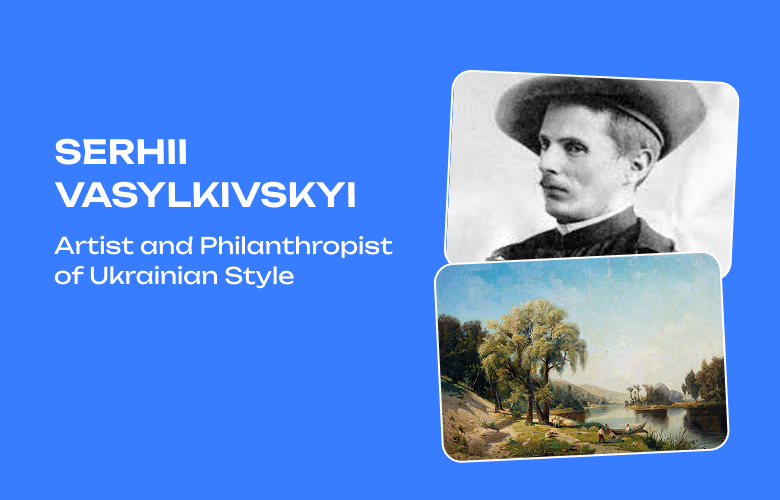
Serhii Vasylkivskyi was a Ukrainian painter, landscape artist, battle painter, researcher of Ukrainian art, and one of the most important artists of Slobozhanshchyna in the late 19th and early 20th centuries. He is often remembered for his Ukrainian landscapes and Cossack scenes. At the same time, his work extended far beyond painting.
Vasylkivskyi worked to ensure that Ukrainian culture had its own recognizable visual language. He painted Ukrainian nature, drew inspiration from Cossack heritage, studied ornamentation, supported art education, participated in architectural projects, produced publications on Ukrainian history and style, and, before his death, donated a significant part of his artistic legacy to a museum.
In this article, we explain why Serhii Vasylkivskyi can confidently be called a philanthropist of Ukrainian art – a man who, through his own work, knowledge, authority, artworks, and financial resources, helped preserve and develop Ukrainian cultural distinctiveness.
Who Was Serhii Vasylkivskyi
Serhii Vasylkivskyi was born in 1854 in Izium, in the Kharkiv region. His family had long been connected to Slobozhanshchyna, and its memory was rooted in the Cossack past. The artist’s grandfather came from a Cossack family and worked as a chumak, while his mother instilled in him a love of folk songs and folklore from an early age.
Vasylkivskyi acquired his first artistic skills in Kharkiv. His teacher was Dmytro Bezperchyi – a student of Karl Bryullov and an acquaintance of Taras Shevchenko. In Kharkiv, the future artist also had access to Ukrainian books, particularly the works of Ivan Kotliarevskyi, Taras Shevchenko, and Mykola Gogol. These works would later influence his understanding of Ukrainian history, culture, and folk life.
In 1876, Vasylkivskyi enrolled at the St. Petersburg Academy of Arts, where he studied in the landscape painting class. His student years were difficult: he lived modestly and often lacked sufficient funds, but he quickly gained recognition. During his studies, he received several academic awards, and for his painting On the Donets, he was awarded a large gold medal and the right to travel abroad for professional development.
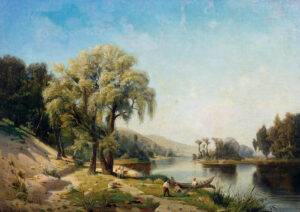
On the Donets. Donetsk Region, 1885
In 1886, Vasylkivskyi traveled abroad. He lived in France, visited European museums, worked in Paris, and exhibited his works there. However, after studying and gaining recognition abroad, he returned to Ukraine. He spent most of his life in Kharkiv, where he worked as an artist, an organizer of the art scene, and a researcher of Ukrainian style.
The Image of Ukraine in Painting
Vasylkivskyi worked at a time when Ukrainian culture was under pressure from the Russian Empire. Following the Valuev Circular of 1863 and the Ems Decree of 1876, the Ukrainian language, printing, and public expressions of Ukrainian distinctiveness were significantly restricted. Under such conditions, art became one of the few ways to speak about Ukraine.
The central image in Vasylkivskyi’s painting was the Ukrainian land. He painted Slobozhanshchyna, Poltavshchyna, the steppes, meadows, rural cottages, roads, and the outskirts of towns and villages. In his landscapes, nature became a vessel for the memory, mood, and character of the region.
Vasylkivskyi often incorporated human figures into natural settings. In many of his works, people do not dominate the landscape at all, but rather become part of it. That is why his landscapes are considered an attempt to convey the overall image of Ukraine—its space, light, silence, history, and dignity.
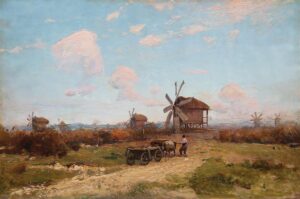
Derkachiv Windmills. Kharkiv Region, 1890
The Cossack theme held a special place in Vasylkivskyi’s work. He turned to images of Cossacks in the steppe, sentries, horsemen, historical figures, and scenes associated with Ukraine’s past. Among his most famous works in this genre are Cossack Picket, Cossack Meadow, Guard of the Zaporizhian Liberties, and Cossack Mamai. Through these subjects, Vasylkivskyi worked with memory. He brought images of Ukrainian history back into art – images that held significant cultural importance under imperial rule.
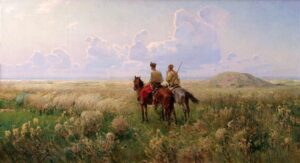
In Defense of the Zaporizhian Liberties, 1890
Ukrainian Style: Ornament, Books, Architecture
Vasylkivskyi also became renowned for his research into Ukrainian art. He was interested in old churches, folk architecture, ornamentation, clothing, everyday life, and the visual features of Ukrainian culture. He traveled throughout Ukraine, sketched historic buildings, collected materials, and worked with what we would now call the Ukrainian visual language.
An important result of this work was the album From Ukrainian Antiquity, created in 1900 together with Mykola Samokysh and with the participation of Dmytro Yavornytsky. The publication featured images of Ukrainian historical figures from the Cossack era and brought the aforementioned Ukrainian historical memory back into the public sphere.
Another significant publication was Motifs of Ukrainian Ornament, prepared by Vasylkivskyi and Samokysh in 1912. It was conceived as an attempt to collect, organize, and pass on the Ukrainian ornamental tradition. For Vasylkivskyi, ornament was an important symbol of cultural continuity and distinctiveness.
The search for a Ukrainian style was also reflected in architecture. One of the most important examples is the building of the Poltava Provincial Zemstvo. Vasylkivskyi advocated for the building to be constructed in the Ukrainian style and later personally participated in its decoration alongside Samokysh. Designed by Vasyl Krychevskyi, the building became one of the first and most important examples of Ukrainian Art Nouveau.
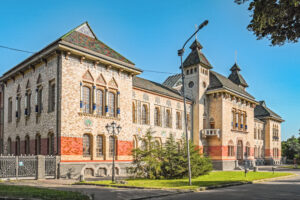
The Poltava Provincial Zemstvo Building
The Art Scene and Museum Work
For many years, Vasylkivskyi was connected to Kharkiv and worked to develop the local art scene. In 1895, together with other artists, he participated in drafting a new charter for the art school in Kharkiv. He was also involved in establishing an art circle and its architecture and art department.
Later, Vasylkivskyi became the organizer and leader of the Kharkiv Literary Circle, which included an art and architecture department. Its members organized exhibitions and promoted both Ukrainian heritage and contemporary art.
Vasylkivskyi also supported museum work. He was a member of the Kyiv City Museum Council, served on the jury for the competition to design a monument to Shevchenko in Kyiv, and participated in artistic and civic initiatives.
Vasylkivskyi’s most notable philanthropic gesture was his will. Before his death, he bequeathed a significant portion of his artistic legacy to the Museum of Sloboda Ukraine. Various sources mention more than 1,300 works. It is also known that he left funds for the creation of a large national art museum in Kharkiv.
In effect, Vasylkivskyi entrusted the museum with an entire layer of Ukrainian art: landscapes, historical scenes, ethnographic observations, Cossack memory, and visual motifs of the Sloboda region. What he had worked on throughout his life was now to become part of the public domain.
Unfortunately, a significant portion of his legacy was lost during World War II. Some of Vasylkivskyi’s works later returned to Ukraine after decades abroad. During the current Russian-Ukrainian war, the issue of preserving museum collections and cultural heritage has once again become particularly acute. On June 14, 2026, the Kharkiv Art Museum, where Vasylkivskyi’s works are housed, came under direct Russian attack: the building’s roof caught fire as a result of the strike, and museum staff, rescue workers, volunteers, and concerned Kharkiv residents joined in evacuating the exhibits. In this context, Vasylkivskyi’s will serves as an important reminder of our responsibility toward culture – a culture that must be preserved and passed on.
Why Vasylkivskyi Is a Philanthropist of Ukrainian Art
Serhii Vasylkivskyi can be called a philanthropist of Ukrainian art not only because of his will, although this gesture is undoubtedly very important. His contribution was broader: he shaped the image of Ukraine in painting, researched and systematized the Ukrainian style, created art publications, supported architectural and museum initiatives, and worked with the Kharkiv art community.
His philanthropy consisted of passing on to future generations of Ukrainians knowledge, images, materials, works, institutions, and the very idea of Ukrainian artistic distinctiveness. By painting and studying Ukraine, he helped make it visible as an independent cultural tradition.
That is precisely why Vasylkivskyi’s legacy can undoubtedly be called philanthropic. It demonstrates that support for culture is not limited to the financial aspect. The long-term work of preserving, organizing, and passing on what shapes our collective memory is by no means less important.