Article
Prepared by the National Network for the Development of Local Philanthropy and the History Museum of the V. N. Karazin Kharkiv National University Museum Complex.
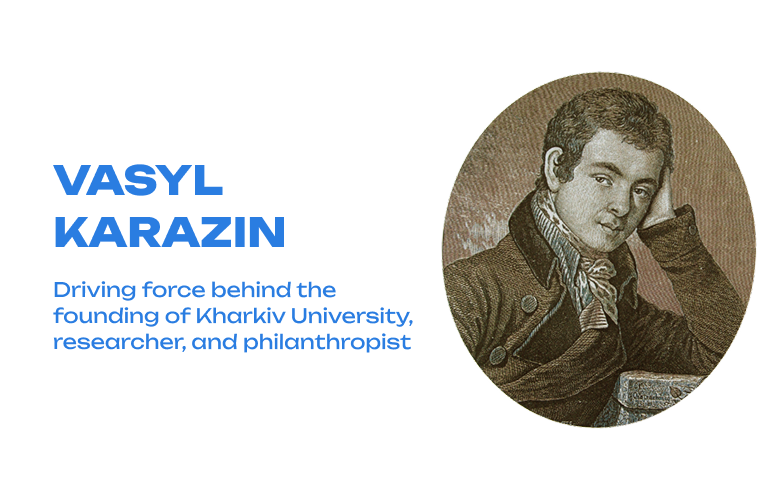
Vasyl Nazarovych Karazin was the driving force behind the establishment of Kharkiv University and a scholar who devoted much of his life to scientific research. With his estate, noble title, and the favor of the Russian emperor, Karazin could have lived the quiet life of a provincial aristocrat. Instead, he chose to risk everything for the sake of advancing education. In this article, prepared in collaboration with V. N. Karazin Kharkiv National University, we explore how Vasyl Karazin went from being a nobleman and military officer to an inventor, educator, and philanthropist, and why his legacy continues to shape Ukraine today.
Vasyl Nazarovych Karazin was born in 1773 in the village of Kruchyk in the Kharkiv region (now Bohodukhiv District, Kharkiv Oblast). On his father’s side, he came from the Karadji family, which likely had Bulgarian, Serbian, or Greek roots, while on his mother’s side he descended from the Cossack Kovalevsky family.
Karazin received his early education at private boarding schools in Kremenchuk and Kharkiv. Later, as was customary for nobles of the Russian Empire, he entered military service in 1791. However, a military career never truly appealed to him. Even during his studies, Karazin developed a passion for the natural sciences and the progressive ideas found in French and German literature. He later became part of the inner circle of Emperor Alexander I, to whom he eventually proposed the idea of establishing a university in Naddniprianshchyna (the Dnipro region).
At the beginning of the nineteenth century, Kharkiv was a small provincial town in Naddniprianshchyna, where an Orthodox collegium had been operating for more than half a century and trade fairs flourished. Karazin’s vision of creating a fundamentally new institution that would provide a comprehensive university education comparable to that of Europe’s leading universities found little support among either the local nobility or officials of the Russian Empire. Most local nobles preferred to establish a military academy for their children instead.
In the summer of 1802, the Kharkiv nobility planned to convene an assembly to thank the emperor for restoring their estate privileges and to raise funds for the construction of a cadet corps. Such a gathering, however, required the emperor’s permission. Alexander I refused, fearing that voluntary donations might effectively become compulsory.
Nevertheless, Karazin later persuaded the emperor to authorize the assembly, explaining that the local nobility wished to contribute funds toward the establishment of a university instead. Researchers believe that, at that point, there was still no officially approved concept for the university, no sufficiently developed justification, and no conclusions from the committee responsible for reforming the statutes of higher educational institutions, where Karazin served as secretary. In fact, the emperor’s approval of the project is known only from Karazin’s own account.
It is therefore Karazin’s persistence that is considered the decisive factor behind the official establishment of Kharkiv University in November 1804. He personally assembled scholarly publications for the future institution, corresponded with invited professors from abroad, and defended the university’s charter before both local and imperial authorities.
Ultimately, when the university officially opened in January 1805, Karazin himself was not invited to the ceremony. History, however, eventually set the record straight. In 1811, he became an honorary member of Kharkiv University, and since 1999 the institution has officially borne his name.
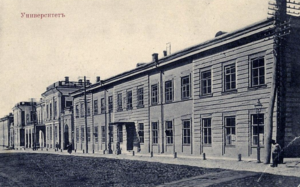
The historic Main Building of Kharkiv University.
Courtesy of V. N. Karazin Kharkiv National University.
Vasyl Karazin’s contribution to the advancement of education and science extended far beyond the founding of Kharkiv University. Despite repeated conflicts with the authorities, he remained committed to scientific research and became a respected natural scientist. He stood at the forefront of meteorological studies in Slobozhanshchyna, worked on the development of agricultural machinery, and even attempted to produce synthetic diamonds. Despite frequent financial hardship, the self-taught scholar carried out chemical experiments at his estate in Kruchyk. Karazin was also among the first to advocate afforestation in Ukraine’s steppe and forest-steppe regions, believing it would improve local environmental conditions.
In 1811, Karazin became head of the Philotechnical Scientific Society, an organization dedicated to promoting scientific knowledge, particularly in agriculture and technology. On his estate, he established experimental fields where different varieties of wheat, rye, and barley were cultivated. Thanks to his agricultural innovations, yields of some crops increased by as much as two-thirds. Peasants on Karazin’s estates were better acquainted with modern farming practices than serfs working on neighboring estates. Karazin also studied Ukraine’s natural resources and was among the first to recognize the unique properties of the Sloviansk mineral springs. Beyond the natural sciences, he maintained a deep interest in literature, history, and antiquities.
Many of Karazin’s ideas were remarkably ahead of their time. During his lifetime, he proposed establishing a women’s vocational school in Kharkiv, where graduates could become primary school teachers, housekeepers, or skilled craftswomen. He also advocated building a modern sewage system to address the city’s sanitation problems.
His belief in the transformative power of education was equally evident in the way he managed his own estate in the Bohodukhiv region, which he sought to turn into a miniature model of the society he envisioned. In Kruchyk, Karazin established a mutual aid fund and reformed the obligations imposed on his serfs, replacing part of their compulsory labour with monetary payments. In 1806, he founded the first school for serf children in Sloboda Ukraine, allocating the considerable sum of 250 rubles annually for its maintenance.
The prominent historian of Sloboda Ukraine, Dmytro Bahalii, cites a letter written by Fedir Manzharenko, clerk of the Kruchyk Village Council founded by Karazin in 1793. In Bahalii’s view, the letter vividly illustrates how local peasants perceived the reforms introduced by Karazin. Written after Karazin’s death, it expresses the belief that nowhere else could an estate and its people be governed better than in Kruchyk. Throughout the letter, Karazin is portrayed as a patriot and a humanist who genuinely cared about the well-being of those who lived and worked on his lands.
Although these initiatives were confined to his own estate, they reflected Karazin’s sincere commitment to supporting the most vulnerable members of society and fostering broader social progress. He also sought to persuade other landowners to follow a similar path by publishing works advocating the reform of serf obligations.
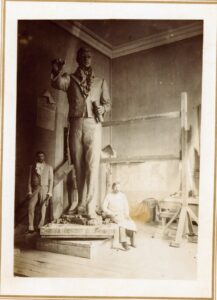
The monument to Vasyl Karazin in the sculptor’s workshop.
Courtesy of V. N. Karazin Kharkiv National University.
The writer Hryhorii Danilevsky first proposed erecting a monument to Vasyl Karazin as early as 1872. However, organizational and financial difficulties significantly delayed the project. It was not until 1903 that the provincial assembly and the University Council approved its construction. The monument was originally intended to be unveiled during the university’s centennial celebrations, but the revolutionary events of the time postponed the ceremony. For nearly two years, Karazin’s statue remained enclosed in a wooden frame in the University Garden and even became the subject of local caricatures.
On June 20, 1907, the monument to the man who inspired the founding of Kharkiv University was finally unveiled. The sculpture was created from a design by Ivan Andrialetti, while the pedestal was designed by the renowned Kharkiv architect Oleksiy Beketov. Karazin is depicted standing in the neoclassical style, capturing the moment he appealed to the people of Kharkiv and the Sloboda-Ukrainian Governorate to support the establishment of a university in 1802. The monument thus became one of the earliest public monuments erected in Kharkiv.
Over the course of more than a century, the monument has been relocated several times. It originally stood on the central avenue of the University Garden before being moved to the grounds of the former St. Anthony’s Church on Universytetska Street. After the opening of the university’s new Main Building, the monument was relocated once again, finally taking its present place near the central entrance in 2004. Today, it greets students and faculty alike, reminding visitors of the man whose vision gave rise to one of Ukraine’s leading universities.
Vasyl Karazin belonged to a generation of the elite of Naddniprianshchyna who believed in the transformative power of liberal social reform. Although many of his contemporaries did not share his ideas or convictions, Karazin sought to bring his vision of an “ideal society” to life on his estate in Kruchyk and became one of the driving forces behind change in Sloboda Ukraine.
His name has endured thanks to his unwavering belief in the power of education and his conviction that investing in it is one of the highest forms of philanthropy. Although Karazin left behind numerous charitable initiatives and significant scholarly achievements, he is remembered above all as the founder of Kharkiv University—an institution that helped transform Slobozhanshchyna and made a lasting contribution to the development of Ukrainian education and national identity.
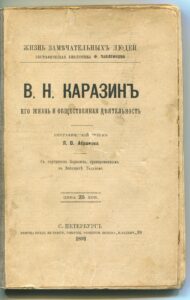
A biographical sketch of Vasyl Karazin, published in 1891.
Courtesy of V. N. Karazin Kharkiv National University.
The information presented in this article is based on materials provided by the staff of the History Museum of the V. N. Karazin Kharkiv National University Museum Complex.