Article
Halshka Hulevychivna was a Volhynian noblewoman, philanthropist, and one of the important figures in the history of Ukrainian education in the early 17th century. Her name is primarily associated with the Kyiv-Mohyla Academy: today, the history of one of Ukraine’s oldest educational institutions is traced back to a deed of donation that Halshka signed more than four hundred years ago.
In 1615, she donated her estate and land in Kyiv’s Podil district for the establishment of a monastery, a hospital, and a school. It was here that the Kyiv Brotherhood School emerged. In 1632, it became part of the Kyiv-Mohyla Colleguim, which later developed into an academy. Students at the school studied five languages, mathematics, astronomy, music, history, philosophy, and theology, while prominent intellectuals of the time, including Iov Boretsky, Meletius Smotrytsky, and Pamvo Berynda, were associated with its intellectual milieu.
In this article, we explore how one noblewoman’s private gift laid the foundation for institutions that still exist today.
Yelyzaveta Vasylivna Hulevych, better known as Halshka Hulevychivna, was born around the 1570s, presumably at the Hulevych family estate in Zaturtsi, Volhynia. She came from an old noble family known in Volhynia since at least the 15th century. Its members owned estates and held administrative and ecclesiastical offices. Halshka’s father, Vasyl, served as deputy starosta of Volodymyr and as Volhynian wojski, while her grandfather, Fedir, or Feodosii, Hulevych, became the Orthodox Bishop of Lutsk and Ostroh.
Halshka was one of the forms of the name Yelyzaveta used at the time. Other variants, including Halshka, Alzhbeta, and Halzhbeta, also appear in historical documents. Even after two marriages, she continued to appear in records under her family name – Halshka Hulevychivna.
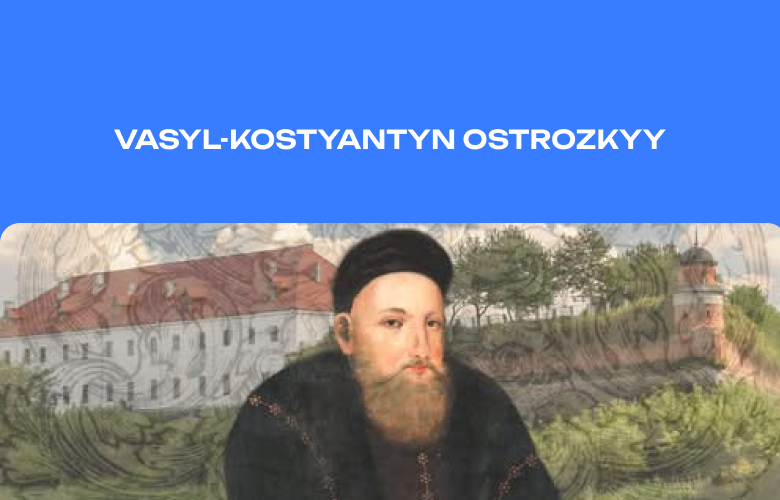
Less is known about her education. Some sources state that Halshka studied at the Ostroh Academy, while others suggest that she was taught by its professors without formally being a student of the institution. In either case, her biography is associated with the milieu of one of the leading Orthodox educational centres of the Rus’ lands at the time – the academy founded several decades earlier by another renowned Ukrainian patron, Vasyl-Kostiantyn Ostrozkyi, whose philanthropic work we discuss in a separate article.
Her family also had an interesting religious background. Halshka’s first husband was Kryshtof Potii, the son of Ipatii Potii – an Orthodox bishop who later became one of the principal initiators of the Union of Brest and a Uniate metropolitan. After Kryshtof’s early death, Halshka was left with their daughter, Kateryna.
Around 1601-1602, Halshka married her second husband, Stefan Lozka, Marshal of Mozyr. The couple lived in Podil, not far from Kyiv’s town hall, and had a son, Mykhailo. It was this Kyiv estate that would soon become the basis of Halshka’s best-known philanthropic foundation.
On October 14, 1615, Halshka drew up and signed a foundation deed. The following day, it was entered into the Kyiv castle court records, giving the donation legal force. Through this document, Hulevychivna formally transferred her estate and land in Podil for the establishment of a monastery, a hospital, and a school.
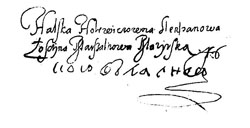
Halshka Hulevychivna’s signature on the 1615 deed of donation.
It is important to understand who the gift was intended for. In the foundation deed, Halshka addressed the Orthodox “people of Rus’” of the Kyiv, Volhynian, and Bratslav voivodeships – clergy, princes, nobility, and people of other social estates. She explicitly stated that she was transferring her own courtyard, land, rights, and appurtenances, leaving nothing from them either to herself or to her descendants.
The purpose of the foundation was also defined quite precisely. The donated land was to accommodate a stauropegial monastery organised around communal monastic life, a school for the children of nobles and townspeople, and a guesthouse for travellers. All of these institutions were to follow the tradition of the Eastern Church of the Greek rite.
This took place at a time of major confessional change following the Union of Brest in 1596. Halshka’s foundation therefore provided the Orthodox community with an institutional space of its own – a school, a monastery, and a place that could provide social assistance.
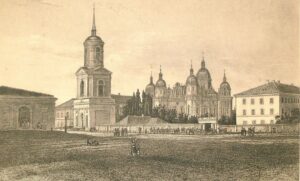
The Epiphany Cathedral and the monastery bell tower in an engraving from the early 19th century.
The property was transferred to the Kyiv Epiphany Brotherhood, whose members included Orthodox nobles, clergy, artisans, and merchants of the city. The monastery was developed under the supervision of Isaia Kopynsky, a monk and future Metropolitan of Kyiv whom Halshka herself mentioned in the deed.
The Kyiv Brotherhood School began operating on the land donated by Hulevychivna, with a curriculum that extended far beyond basic literacy. Students studied Church Slavonic, “Slavonic-Ruthenian,” Greek, Latin, and Polish. The curriculum also included arithmetic, geometry, astronomy, music, history, poetics, philosophy, and theology.
In 1632, Metropolitan Petro Mohyla merged the Kyiv Brotherhood School with the school of the Kyiv-Pechersk Lavra. This gave rise to the Kyiv-Mohyla Collegium. In the 1630s, new buildings were constructed for the institution at Mohyla’s expense, and in 1701, during the hetmancy of Ivan Mazepa, it was granted the status of an academy.
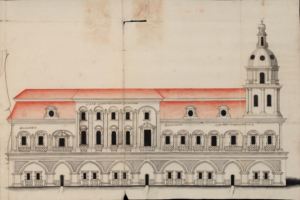
Design for the expansion of the Old Academic Building, early 18th century.
The Kyiv-Mohyla Academy became one of the leading educational and intellectual centres of the Ukrainian lands in the 17th and 18th centuries. At various times, it was associated with philosopher Hryhorii Skovoroda, theologian and thinker Theophan Prokopovych, and hetmans Ivan Mazepa and Pylyp Orlyk. Its alumni worked in ecclesiastical, educational, cultural, and political spheres, taught, and established educational centres far beyond Kyiv.
For this reason, today’s National University of Kyiv-Mohyla Academy traces its history back to October 15, 1615. The date is still celebrated as Academy Day.
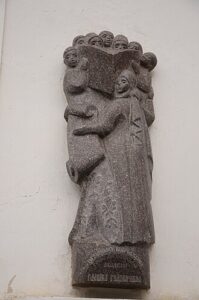
Granite bas-relief of Halshka on the façade of the Old Academic Building of the Kyiv-Mohyla Academy.
One of the oldest buildings in the Academy’s present-day complex is also associated with Halshka’s original estate. After new buildings were constructed at Petro Mohyla’s expense in the 1630s, the old structure – traditionally identified as Hulevychivna’s house – served as the monastery kitchen. Meetings of the Academy’s governing body were also held there. The building has survived in Podil to this day and was restored in 2002.
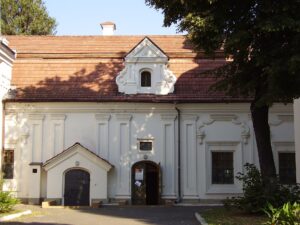
Halshka Hulevychivna’s house in Podil, also known as the “Povarnia” (“Kitchen”).
The attribution of the building, however, is not entirely straightforward. Researchers have located the so-called “Halshka House” on the site of the Brotherhood Monastery’s kitchen, but archaeological investigations have found no material in the present structure dating from earlier than the turn of the 17th and 18th centuries. The direct connection between the surviving building and the house Halshka donated to the Brotherhood in 1615 therefore remains a matter of debate.
After the death of her second husband, Stefan Lozka, in 1618, Halshka became the guardian of their son, Mykhailo. She later left the family estates to him and returned to Volhynia. The final years of her life were connected with Lutsk and the local Brotherhood of the Exaltation of the Holy Cross.
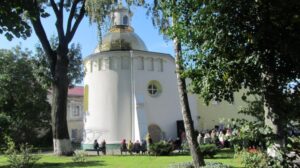
The Church of the Exaltation of the Holy Cross in Lutsk.
The Brotherhood emerged around 1617 and became one of the leading Orthodox religious and educational centres in Volhynia. Its activities extended well beyond the church itself. In 1619, the Brotherhood received royal permission to rebuild a hospital – a refuge for the sick and infirm. That same year, 46 representatives of the nobility and clergy entrusted Lutsk townspeople with developing a school, church, and monastery.
By the 1620s, a Greek-Latin-Slavonic school operated under the Brotherhood, with a separate building constructed for it. The school had its own statute, while students from poor families could study free of charge and receive food, clothing, and medical care. At its height, the Lutsk Brotherhood School ranked among the leading Brotherhood schools in the Ukrainian lands.
The Brotherhood also developed book printing. In 1628, Lament for Father Ivan Vasylovych, a collection of Baroque elegiac poems written by teachers and students of the Brotherhood School, was printed in Lutsk. Yov Kondzelevych, one of the best-known Ukrainian icon painters of the 17th and 18th centuries, is also associated with this milieu.
These were the institutions Halshka supported toward the end of her life. On April 2, 1641, she drew up her will. According to one study, her cash and outstanding debts owed to her amounted to approximately 4,500 zlotys.
Halshka specified several donations individually: she allocated 200 zlotys to the Brotherhood Church of the Exaltation of the Holy Cross, another 200 to the Brotherhood monastery, and 50 to its hospital. She left 30 zlotys to the Chernchytsi convent and another 10 zlotys each to two priests.
In her will, Halshka also expressed her wish to be buried at the Brotherhood Church of the Exaltation of the Holy Cross. She died in 1642, and on March 31 her testament was entered into the Lutsk castle court records.
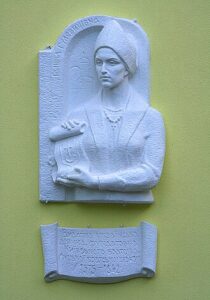
Bas-relief of Halshka Hulevychivna on the Church of the Exaltation of the Holy Cross in Lutsk.
The history of Halshka’s deed of donation also proved complicated. Its original has never been found, nor has any copy dating from the 17th century. The earliest known text is a handwritten copy preserved in a copybook of the Kyiv Brotherhood Monastery from the second half of the 18th century. In 1774, Metropolitan Havryil of Kyiv submitted it to the Holy Synod together with other documents from the Academy, while the text of the deed itself was first published in 1846.
Interestingly, Halshka did not always occupy a central place in accounts of the Academy’s history. Until the mid-18th century, the institution’s founding was associated primarily with Petro Mohyla and Petro Konashevych-Sahaidachny.
Academy professors began paying greater attention to Hulevychivna in the 1760s, when a dispute arose over a possible reform of the institution by the Cossack officer elite. Tracing the Academy’s history further back helped establish its origins in a noble foundation dating to 1615. The story of how Halshka herself re-emerged in historical memory as the school’s founder has therefore become a subject of scholarly research in its own right.
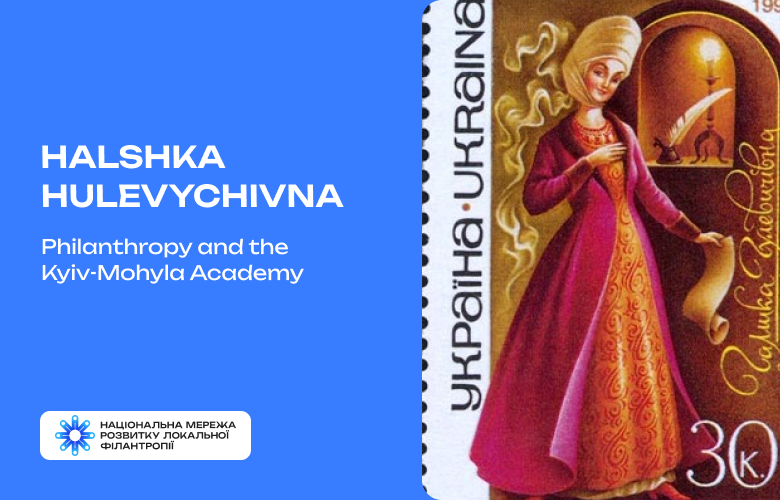
There is another curious aspect of Halshka’s legacy: we do not know what she actually looked like.
No authentic painted or graphic portrait created during her lifetime has survived. All of the images of Hulevychivna familiar to us today are therefore later artistic interpretations.
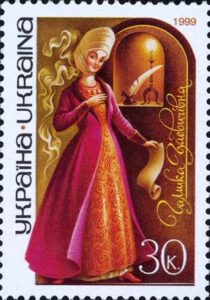
Ukrainian postage stamp depicting Halshka Hulevychivna.
In 1997, the Kyiv-Mohyla Academy even held a special competition to create an imagined portrait of Halshka. Nearly 30 professional artists and students took part in the exhibition The Image of a Woman – The Image of a Nation.
Halshka Hulevychivna gave the community what she had – her own estate and land. A school opened on that site, later becoming part of the Kyiv-Mohyla Collegium and, eventually, the Academy. Toward the end of her life, Halshka continued supporting Brotherhood institutions, this time in Lutsk.
In both cases, her donations became resources for institutions that served others: places where people received an education, where the sick and poor were cared for, and where religious and civic life developed. The institution established in Kyiv was then expanded by subsequent generations, from Petro Mohyla to Ivan Mazepa.
The impact of Halshka’s best-known gift ultimately extended far beyond the estate she donated in 1615. In 2021, the Holy Synod of the Orthodox Church of Ukraine blessed her local veneration in the historical region of Volhynia and in Kyiv, and in February 2022 she was canonised as Righteous Yelyzaveta Hulevych.
More than four hundred years have passed, yet the institution whose origins she helped shape continues to operate. Perhaps this is the clearest testament to just how far the impact of a single philanthropist’s gift can reach.
Sources: